Ray tracing’s hidden bill
Ray tracing has a hidden bill. Every time something in a scene moves, the GPU has to rebuild or update the structures it uses to work out what a ray hits. On 28 October the DirectX team published a preview of new DirectX Raytracing (DXR) features aimed squarely at that bill, and the pitch is simple: stop paying for the whole world when only a corner of it changed.
The preview ships in Agility SDK 1.722-preview and adds three things: Clustered Geometry (built from CLAS, cluster-level acceleration structures), Partitioned Top-Level Acceleration Structures (PTLAS), and indirect, GPU-driven acceleration-structure builds. Microsoft’s Amar Patel says that for DXR this is the most significant update since its debut in 2018. It is also a developer preview, so there is nothing for you to switch on in a game menu.
What the three pieces actually do
Clustered Geometry breaks the unit of building down into small reusable clusters of triangles. A single CLAS holds an indexed mesh of up to 256 triangles and 256 vertices, and a bottom-level structure is then assembled from a list of them. Microsoft’s reasoning is that animation, streaming and generated geometry can repeatedly force the expensive rebuild of large bottom-level structures, and clusters let you reuse work instead. If builds get cheap enough, the blog says it can become practical to ray trace the same full-detail geometry used for rasterisation rather than simplified stand-ins, so ray-traced shadows and reflections match what you see.
Partitioned TLAS tackles the scene-wide side. Updating a top-level structure can be costly in a large world even when only a few instances moved. PTLAS groups instances into partitions, retains the data for partitions that did not change, and focuses the update cost on the regions that did. The third piece, indirect builds, lets the arguments for those operations live in GPU memory, so compute shaders can generate them rather than the CPU describing every build.
Microsoft says the features can be used separately or together, and that they do not need new hardware capabilities beyond existing ray tracing support. The catch is that each vendor still has to implement and validate drivers for each GPU generation.
The domino numbers, and what they do not prove
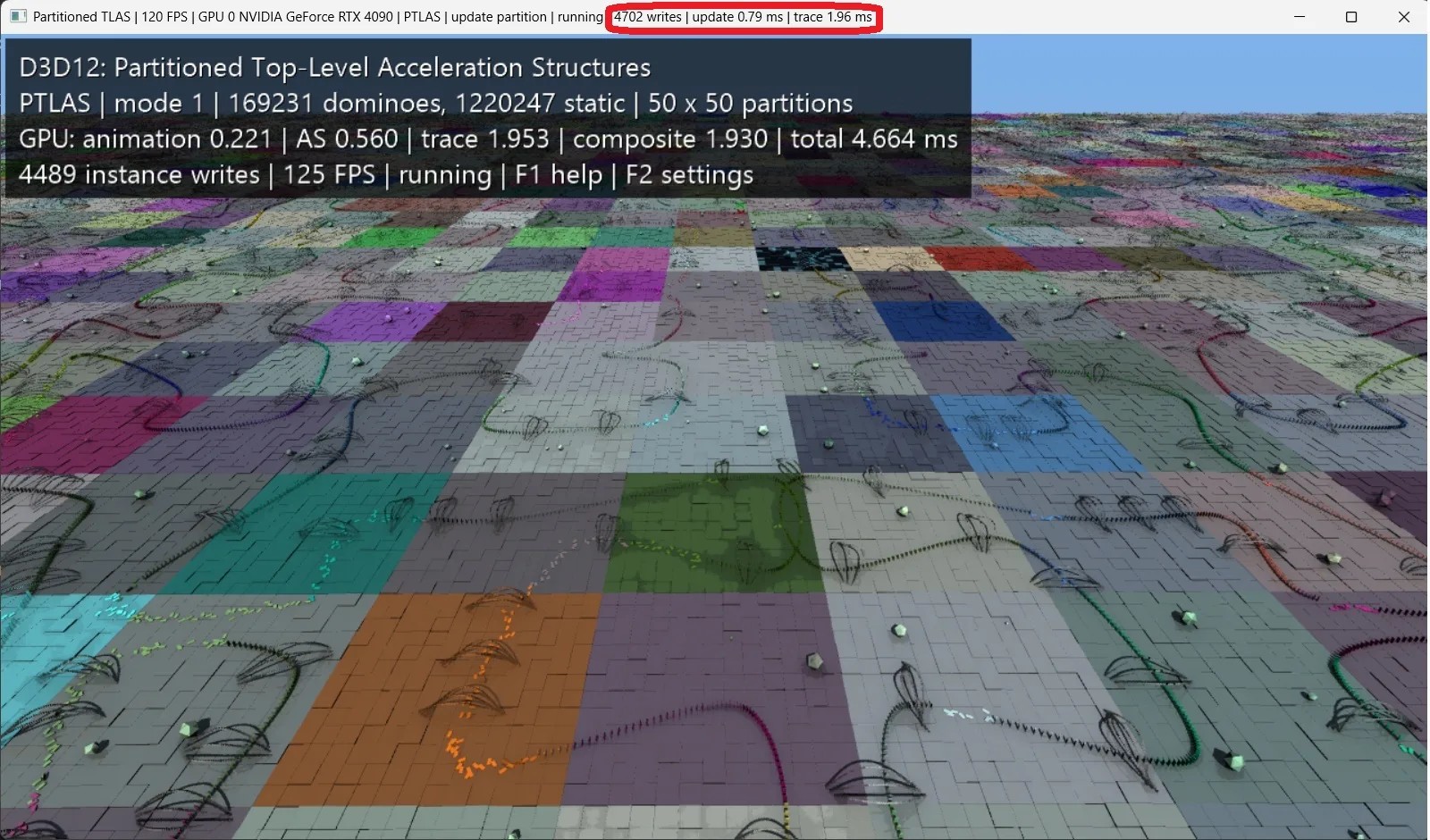
The clearest demonstration is a D3D12 sample contributed by NVIDIA to Microsoft’s samples repository: a world of falling dominoes and static scenery. Microsoft’s description is that the plain TLAS needs a full rebuild every frame and takes 2.88 ms, while PTLAS with localised writes takes 0.79 ms. The blog adds that PTLAS trace time is a bit slower in this sample, but the trade is worth it. The screenshots show the same scene in both modes, with the overlay reading 116 FPS for TLAS and 125 FPS for PTLAS, and an NVIDIA GeForce RTX 4090 in the title bar of the PTLAS shot.
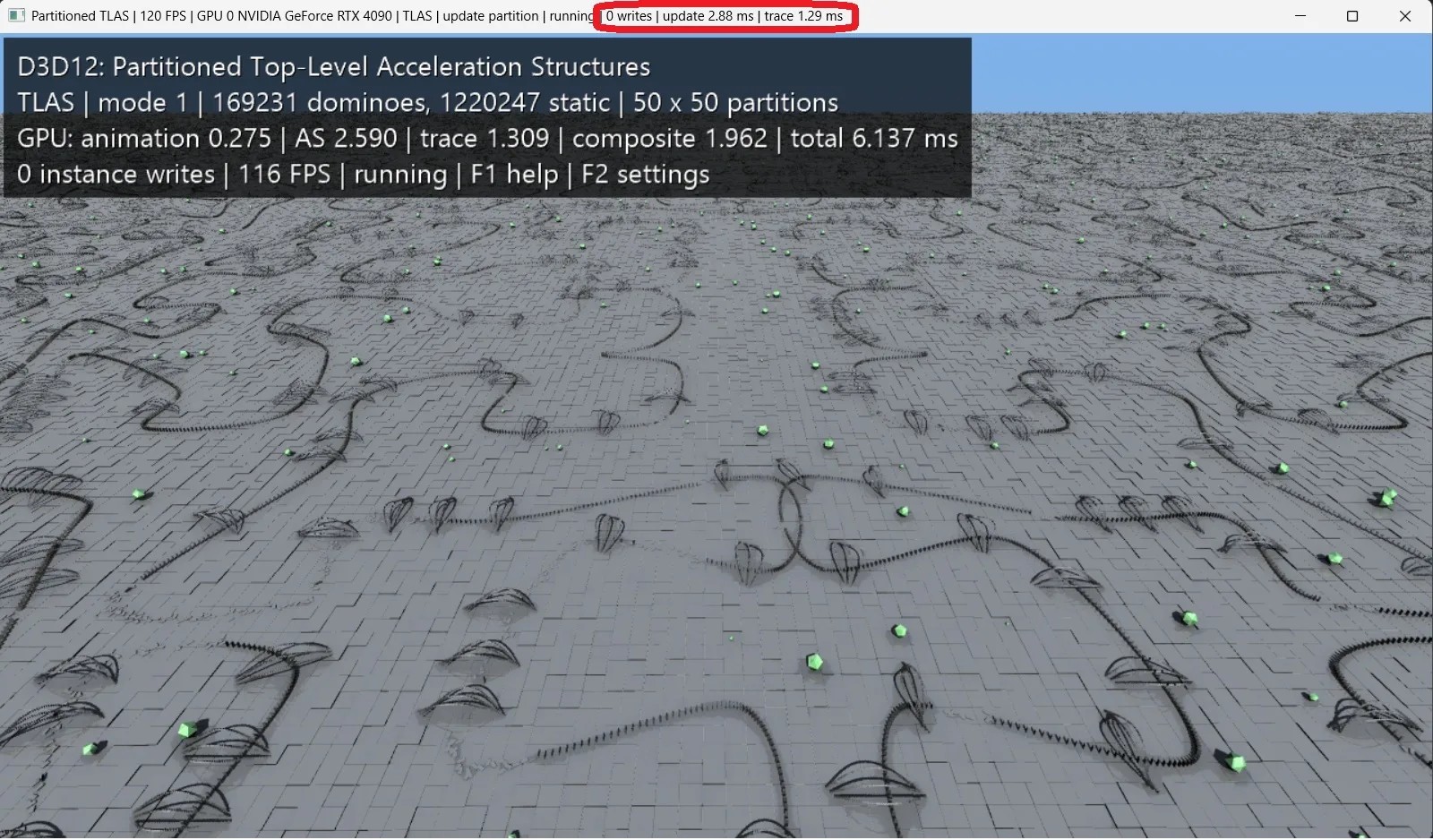
Read that as one sample on one setup, not a forecast. The overlay figures are from that one capture, so treat them as an illustration of the idea. The same post includes a clustered geometry test on an AMD Radeon RX 9070 where per-frame build time fell from 788 ms to 3.11 ms. Microsoft attaches an all-caps warning to that one: do not assume games will see this magnitude of wins, it is a test playground. It also notes that clustered builds needed far more scratch memory in that test, and that there can be cases where tracing rays is slower but the saved build time more than makes up for it.
Which GPUs and drivers, per Microsoft’s blog
Support is listed per vendor, and the driver status differs. NVIDIA says it supports the update on all RTX GPUs, with the official NVIDIA drivers or the NVIDIA App. AMD lists Radeon RX 9000 series cards on a developer preview driver, AMD Software: Agility SDK Developer Preview Edition 26.20.12.01. Intel lists Arc B-Series graphics and the Core Ultra processor family (200V series, Series 3) through its Intel Graphics Beta Preview Feature Driver. Qualcomm support is planned, with driver availability targeted for Q1/Q2 2027 on Snapdragon X2 platforms.
| Vendor | Supported hardware (per Microsoft) | Driver status |
|---|---|---|
| NVIDIA | All RTX GPUs | Official NVIDIA drivers |
| AMD | Radeon RX 9000 series | Developer preview driver 26.20.12.01 |
| Intel | Arc B-Series; Core Ultra (200V series, Series 3) | Beta preview feature driver |
| Qualcomm | Snapdragon X2 platforms | Planned, targeted Q1/Q2 2027 |
Microsoft also says support for some older ray tracing GPUs is still to be determined, because implementation work may uncover performance issues that make exposing the features impractical. That is worth remembering if you are on an older card. We have already seen path-traced features draw a hard line through older hardware, as in our report on the path-traced Minecraft Java Edition beta that leaves RTX 20 Series owners out, so a vendor-by-vendor list is the thing to watch. Developers also need preview headers and runtime, a supporting driver and Windows Developer Mode to try any of this today.
Plumbing, not a toggle
Our view: this is the kind of change that matters a lot and shows up as nothing. You will not get a new setting. If it works, a developer with a dense, animated, streamed world gets a cheaper way to keep ray tracing in step with what is on screen, and that headroom can go to frame rate or to more of the scene being traced. If it does not get adopted, nothing changes. The payoff depends on studios using it and on drivers staying solid across hardware generations.
There is one early signal. Microsoft says Gears of War: E-Day is an early example of a title adopting clustered geometry through NVIDIA’s vendor-specific API, RTX Mega Geometry, and that standardising it in DirectX gives future titles a common path across supporting hardware. That is the blog’s example of the concept, not a statement that any game will use the new DirectX preview. For now it is a preview, and we will treat any ray-tracing performance claim as unproven until a shipping game exercises it.
Microsoft’s companion Agility SDK post also updates Advanced Shader Delivery, which we explained in our guide to Advanced Shader Delivery and which GPUs support it. Shader Model 6.10, which the clustered geometry intrinsics rely on, remains in preview, and Microsoft points to Agility SDK 1.621 retail in early December for it. The ray tracing features themselves stay in preview, and Microsoft hasn’t given them a retail date.