A bigger chiplet, no Ryzen
The Zen 6 12-core chiplet is the one detail from AMD’s server launch that PC gamers should circle, and there is no Ryzen attached to it yet. AMD announced general availability of its 6th Gen EPYC server processors, built on Zen 6, on 10 November 2026. The core details that came with them will eventually power Ryzen desktop and laptop chips too, The Register reports.
Twelve cores on one die
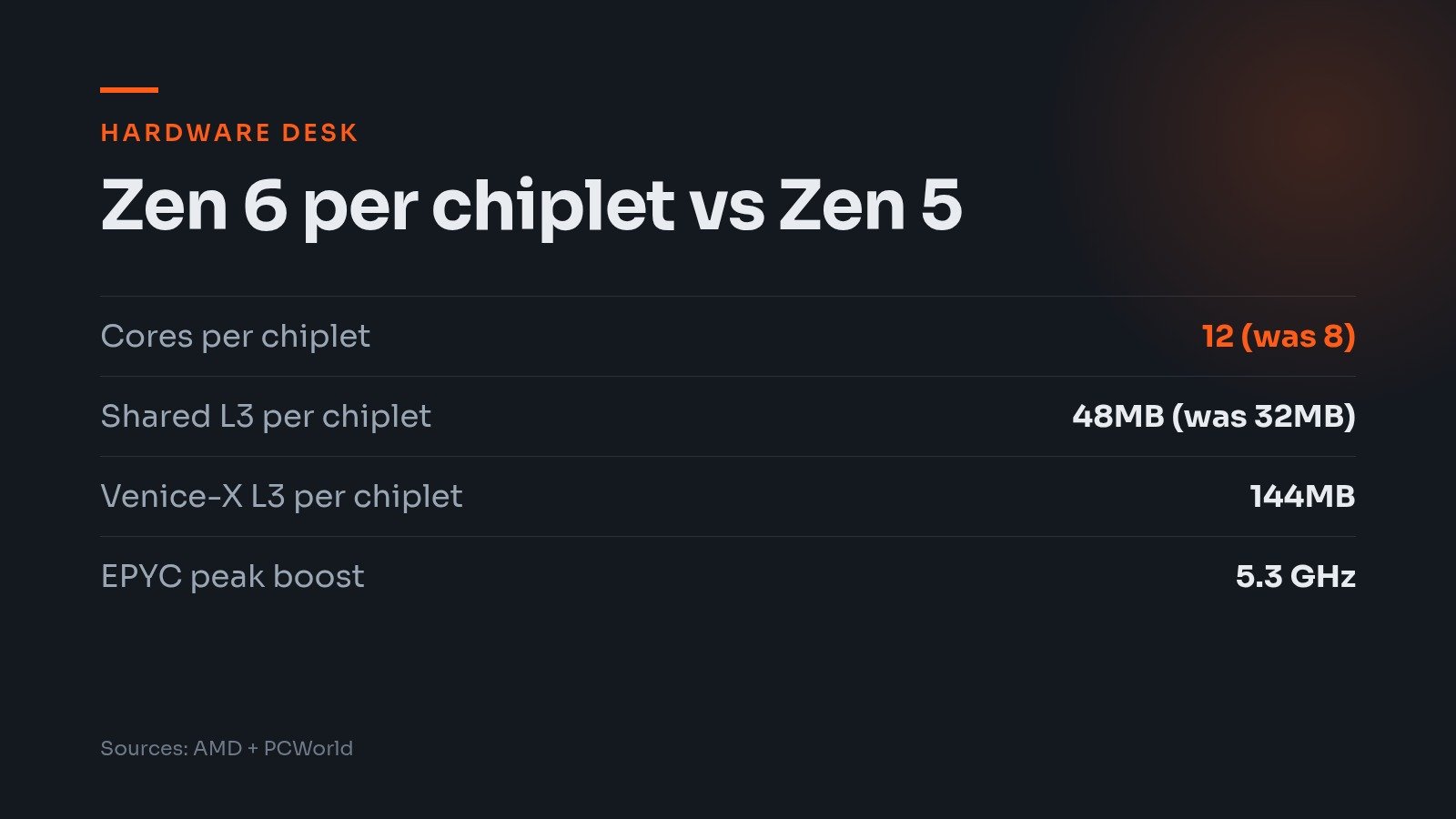
A chiplet, or core complex die (CCD), is a group of cores sharing a pool of L3 cache. PCWorld’s analysis says Zen 6 puts 12 full-performance cores and 48MB of shared L3 on one, up from eight cores and 32MB with Zen 5. Cache per core stays at 4MB.
That matters because today’s 12-core Ryzen chips need two CCDs, and talking between chiplets takes longer than talking within one. Games with tightly connected threads spread across both can pay a latency penalty. A future 12-core Ryzen could fit on a single CCD. The caveat: games that already keep their critical threads on one CCD wouldn’t necessarily gain anything.
Venice-X shows the cache ceiling
AMD’s Venice-X server parts pair that 48MB with 96MB of stacked 3D V-Cache, for 144MB of L3 per 12-core CCD. For comparison, today’s eight-core Ryzen X3D chips offer 96MB of total L3. AMD hasn’t announced a 144MB Ryzen X3D, or any Zen 6 Ryzen X3D at all.
What it does show is that Zen 6 can pair 12 full-performance cores with a big shared cache, the approach behind X3D’s results in cache-sensitive games. A single cache-rich 12-core CCD could also simplify the scheduling logic that steers games toward the right cores on today’s dual-chiplet X3D chips.
The 27% figure isn’t a gaming number
AMD’s roughly 27 percent IPC uplift is a geometric mean for the denser Zen 6c variant across AI and server workloads, PCWorld says. It is not a gaming benchmark. The Register puts AMD’s claimed gain over Zen 5 at 20 to 31 percent for cloud and AI workloads, with the gains not all landing on the same SKU. Venice’s own headline numbers are server-sized too: up to 256 cores and boost clocks of up to 5.3 GHz.
Zen 5 is the cautionary tale. Ryzen 9000 owners reported gains of roughly 5 percent in games, which The Register says earned the nickname “Zen 5 percent”, because game engines weren’t CPU-bottlenecked. AMD’s Mike Clark told The Register that PC buyers expect more than a 6 percent gain from Zen 6.
Don’t wait on a chip that doesn’t exist
We think anyone eyeing a 9800X3D today should buy on what’s on shelves. AMD isn’t ready to talk about Ryzen yet, and there is no product name, release date or price for a Zen 6 Ryzen of any kind. A single-chiplet 12-core X3D is a tempting idea on paper, but PCWorld’s own verdict is that real gaming gains won’t be known until independent Ryzen benchmarks arrive. If you’re weighing the current chips, our look at the 9800X3D’s gap over the 7800X3D is the better guide, and you can price a build in our PC Builder.
Expect rumours anyway. AMD’s consumer naming has already slipped out elsewhere, with Microsoft naming Ryzen AI 500 before AMD did. Treat anything about a Zen 6 Ryzen as a rumour until AMD puts a name, a date and a price on it.