Valve’s answer to clones
Valve’s answer to AI clones sounds a lot like its old answer to piracy: make the genuine game the best version of itself, then keep making it better.
Tom Giardino and Marc Wilkinson of Valve’s Steam business team took developer questions at the Steam Indie Connect event in Busan, South Korea, on 27 October, and Inven Global reported the answers. The quotes below are as reported and translated by Inven, not Valve’s own English transcript.
Valve won’t police tools, and points the extortion at the police
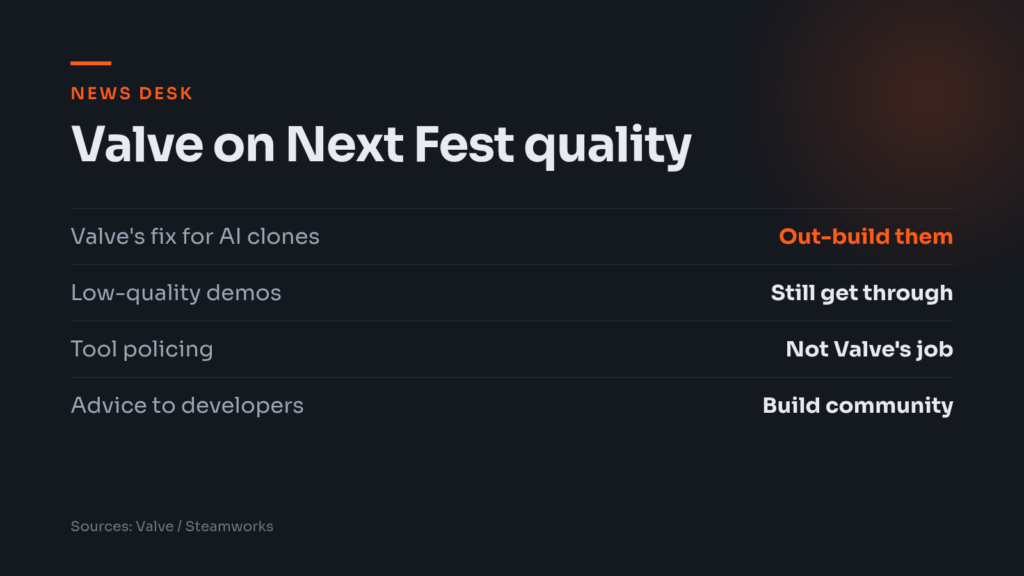
The AI-clone question started with a developer who said indie studios have been getting emails that read, in Inven’s rendering, “If you don’t pay, we’ll clone your game with AI and release it first.” Giardino said it was the first time he had heard of such cases. “We don’t want to be gatekeepers telling developers which tools they should or shouldn’t use,” he said, adding that clone games existed long before AI and that AI has only sped them up.
He called the extortion itself closer to a matter for law enforcement than for a game platform. Even so, he said, “If you report such cases to us, we want to look into them further and help in whatever way we can.”
Rather than relying on a single mechanic that someone can easily copy, you need to keep growing your game by adding features, personality, and creativity that stem from your own perspective.
Tom Giardino, Valve, as reported by Inven Global
Inven says Giardino drew the piracy comparison himself: Valve has historically not been aggressive with DRM, putting its weight on making the legitimate version the best one available. Community, he said, is the first line of defence against clones, but it takes time and doesn’t happen automatically, so it isn’t enough alone.
Next Fest opens on a coin toss, and Valve knows it
On the flood of low-effort demos, Wilkinson explained that for the first two days of Next Fest, games are shown to players on a virtually random basis, with personalised recommendations kicking in afterwards. Per Inven, the random start is there to stop people gaming early visibility and to give every game a fair share of exposure. He also said many articles complaining about low-quality games were based only on those first two days.
“We recognize that the trade-off is some low-quality games get exposed,” Wilkinson said. “We are fully aware of the situation, and a significant number of people are thinking about how to solve this problem.”
The scale is the problem. Market data firm Alinea Analytics counted more than 7,300 demos in October’s Next Fest, against roughly 4,400 in June, according to This Week in Videogames. Its report adds that only four of the eventual top 50 most-played games carried AI disclosures. Giardino recalled that three years ago he was telling developers “There are only 50 or 100 games, so you should definitely join”; now, he said, it’s “the pendulum swinging to the opposite side.”
The same session doubled as a state-of-Steam tour. Giardino’s slides put Steam’s recent peak at 43.5 million concurrent users, the record we covered earlier this month, and Wilkinson presented Personal Calendar, which we wrote up on 28 October, as an official store feature now that it has left Steam Labs.
Build-a-community advice doesn’t reach the people who are scared now
The fear is already changing behaviour. This Week in Videogames notes that the developers of ReVamp and Drunken Goddess Reflux cancelled public demos and playtests in favour of smaller, private tests. PC Gamer quoted Israel Mallén of Digital Sun Games suggesting storefronts could give developers “more tools to vet who gets access [to pre-release builds], like account age, playtime or review history.” PC Gamer’s read is that major changes of that sort don’t sound imminent, and Inven’s own verdict is that Valve presented no definitive solution to slop or cloning.
We think Valve’s position is at least consistent. Giardino pointed out that when Greenlight and then Steam Direct arrived, developers asked for ways to filter those games out, and Valve chose to improve the shopping experience instead. But consistent isn’t the same as helpful. Community and a steady update schedule protect a game people already know about; the worry in Busan was what happens before launch, when a public demo or playtest is the exposure a developer is weighing. Until Valve says what “thinking about how to solve this problem” actually means, and when, we’d treat “make a better game” as advice rather than a plan.