Screen wins, cooling splits
The screen is the one thing all three reviews of Corsair’s iCUE LINK TITAN II 360 RX LCD like. The cooling is where they part ways, and at $239.99 that’s the part you’re paying for.
A 5-inch screen that earns its keep
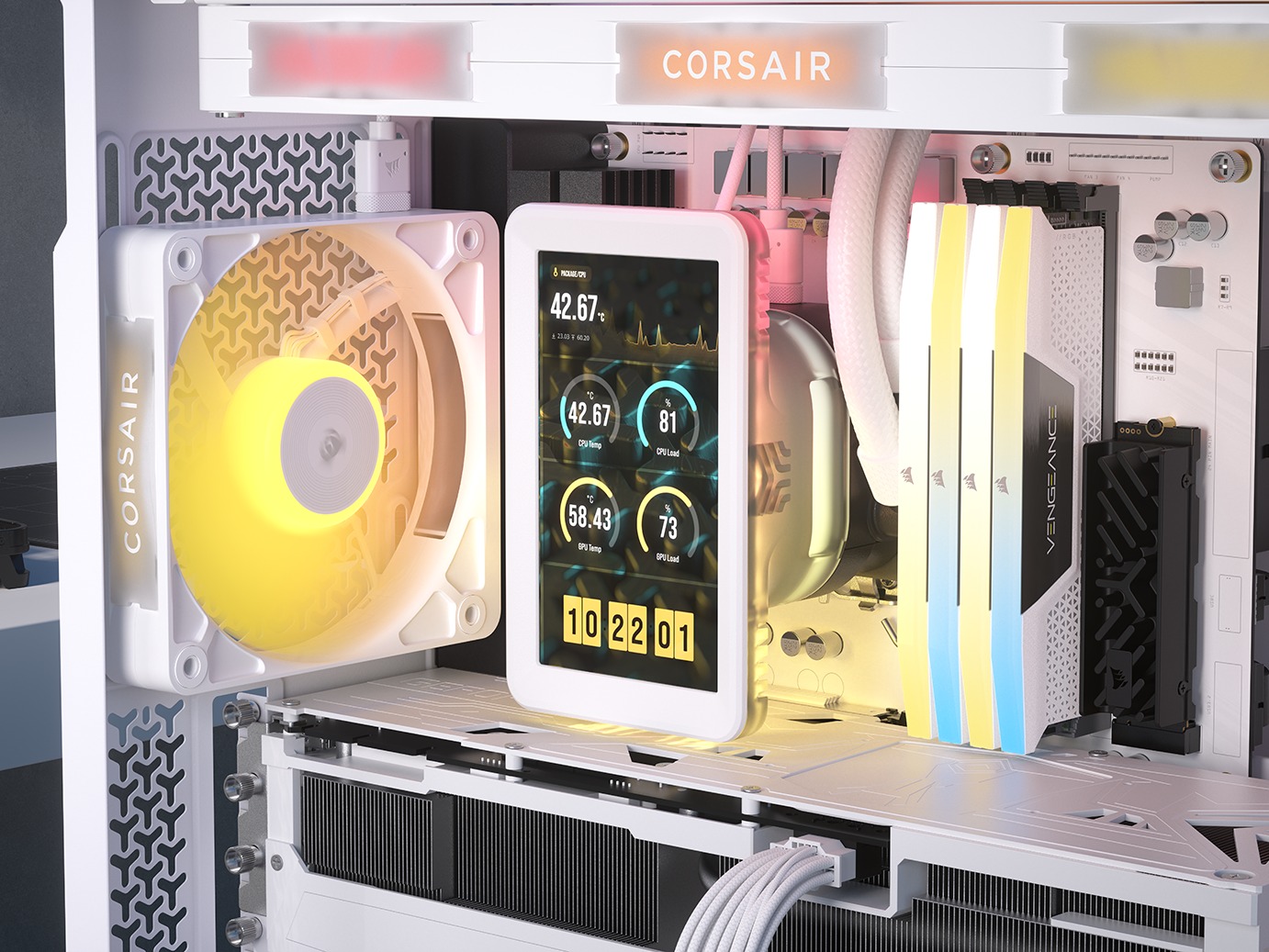
The headline feature is a 5-inch IPS panel on the pump head, 720×1280 at 60 Hz. TechPowerUp lists it in its pros as “vibrant and useful”, Hardware Busters calls it “large and sharp”, and Tech2Geek says it’s “large, bright, and genuinely useful rather than merely decorative”. TechPowerUp also notes that the pump can be rotated 90° at installation, so the display can sit horizontally and work as a 720p screen.
The price of admission is a cable. Hardware Busters flags that the screen needs a DisplayPort output. Tech2Geek confirmed that Windows then treats it as a full monitor, with wallpaper and taskbar, but was “considerably less impressed” by the connection: it means routing an extra video cable out of the case to the graphics card, though Corsair supplies a PCIe slot bracket for the job.
Two reviews say mid-pack, one says solid
TechPowerUp calls the performance “a mixed bag” across its AMD and Intel test platforms. The cooler, it says, falls behind coolers that are “half the price” on performance alone, whether fans are maxed or compared at the same 45 dBA, and it measured it 2–3 °C behind the best performers. It also found the horizontal pump orientation better by about 1–2 °C, which by its reckoning puts a vertical-display setup 3–5 °C behind. Its summary: “a middle of the pack 360 mm AIO in terms of pure performance metrics”.
Hardware Busters is blunter. On its Ryzen 9 7900X the TITAN II ranks 16th to 19th in the overall performance charts, and the first-generation Titan 360 RX LCD it replaces scores 5 to 9% higher at every noise level. At 25 dBA, 17 coolers score higher, 16 of them cheaper. Tech2Geek reports that Corsair claims better efficiency at normalised noise than the first generation; Hardware Busters’ charts say otherwise.
Tech2Geek tested a Ryzen 9 9950X3D in an open case at about 22°C, with the CPU power limit locked at fixed steps and the fans and pump at maximum. It recorded 35°C at 50 W, 55°C at 100 W, 70°C at 150 W and 84°C at 200 W, then hit the chip’s 95°C TJmax at 250 W, with throttling at around 243 W. It says that limit reflects the processor rather than the cooler’s ceiling. Those figures come with no rival coolers charted beside them, so they can’t answer the question the other two raise.
| Outlet | Verdict | Key number |
|---|---|---|
| TechPowerUp | “Can’t wholeheartedly recommend it” | 2–3 °C behind the best performers |
| Hardware Busters | Can’t recommend it for cooling at $239.99 | 16th to 19th on a Ryzen 9 7900X |
| Tech2Geek | Recommended Award | 95°C TJmax at 250 W on a Ryzen 9 9950X3D |
Quiet fans, a restless VRM fan
Noise is the cooler’s better story, with a catch in the numbers. TechPowerUp says the pump and fans stay quiet until you push past 65–70% PWM, after which noise climbs quickly to a 58 dBA maximum, all of it fan noise. Tech2Geek measured 34 dBA at 25% fan speed and 45.8 dBA at full speed with fans and pump maxed. Those maximums are about 12 dBA apart, and the reviews don’t reconcile them.
The 70 mm VRM fan on the screen module splits opinion too. TechPowerUp found it added no serious noise but offered little airflow and made little difference on an open bench; it says the fan will make a bigger impact in a smaller system. Hardware Busters says it never stops and the fan cannot be switched off. Tech2Geek watched it swing between roughly 1,500 and more than 3,000 RPM depending on load, which it called “considerably more aggressive”.
What $239.99 does and doesn’t buy
TechPowerUp lists an MSRP of $239.99, and Hardware Busters frames its verdict at the same $239.99. Tech2Geek says it was due on sale from 25 August 2026 and that the screenless RX RGB version costs $195. Its own numbers wobble a little, though: its text says $240 for the LCD while its comparison table says $265, and the standalone screen module is $99.99 at launch in one place and $105 in its conclusion.
Hardware Busters says the TITAN II costs $20 more than the model it replaces, and in its performance-per-price chart only be quiet!’s Light Loop IO LCD ranks lower. TechPowerUp rates performance per dollar “abysmal regardless of platform”, praises the six-year warranty, and says the cooler might be more competitive “closer to $200”. It adds that spending a bit more can get an OLED-equipped rival.
Not every build needs a screen on the pump. We covered a Newegg Ryzen 7 9800X3D deal with a free 240mm AIO, which is a very different sort of money. And if you’re pairing a big cooler with a gaming chip like that one, our Ryzen 7 9800X3D review roundup covers what the labs say about the CPU.
Our take
We think the TITAN II LCD is best understood as a display purchase that happens to include a cooler. Even Tech2Geek, the one outlet giving it an award, rests its case on “the real strength of this version”, the screen, and says plainly it isn’t aimed at users looking solely for the best performance per dollar. None of the three gave a numeric score, so our 67 out of 100 is our own mapping of their verdicts: 85 for Tech2Geek’s Recommended Award, 65 for TechPowerUp’s “can’t wholeheartedly recommend”, 50 for Hardware Busters’ “cannot recommend” for cooling, averaged. It is not a score any outlet gave.
- Buy if you already live in Corsair’s iCUE ecosystem and want a large, bright screen on the pump, and a PC with a spare DisplayPort connection to the graphics card.
- Skip if you’re shopping on cooling per dollar. Hardware Busters found 16 cheaper coolers that score higher at 25 dBA on a Ryzen 9 7900X.
- Wait if the screen is the draw but $239.99 isn’t. TechPowerUp’s $200 line is a fair target to watch for.
One option is worth a look: Tech2Geek says the standalone 5-inch module is backward compatible with Corsair’s CapSwap ecosystem, including the first-generation iCUE LINK TITAN coolers. For a cooler-first buyer, the numbers point elsewhere. For a screen-first buyer, the screen is the part all three reviews single out.
Sources checked 29 October 2026: TechPowerUp, Hardware Busters and Tech2Geek. Prices are as each outlet reported them.